Kymen Seudun Osuuskauppa found solutions to reduce musculoskeletal strain
/ Article
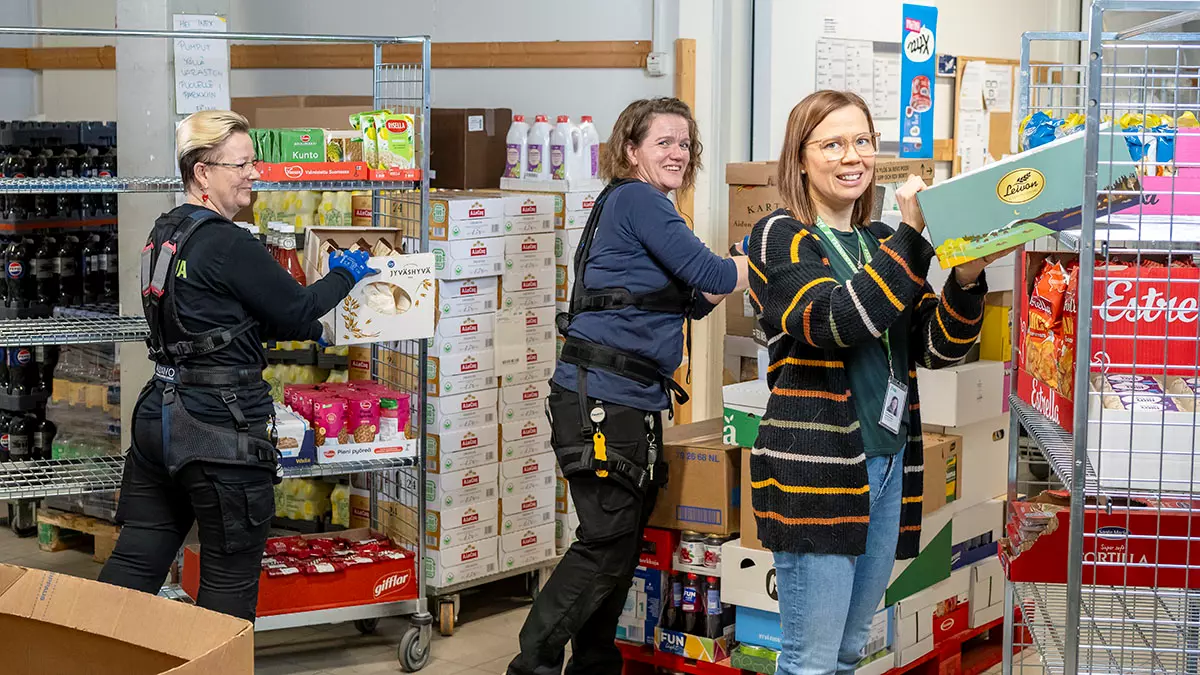
Ergo ambassadors Mari and Terhi, together with work wellbeing specialist Tytti, promote the use of exoskeletons at Kymen Seudun Osuuskauppa.
Musculoskeletal disorders remain a significant reason for sickness allowance, even though sickness absences and disability pensions due to mental health reasons are increasing. According to statistics from Kela, around 78,000 people received sickness allowance due to a musculoskeletal disorder in 2025. Conditions related to physical strain were also the most common reason for moving onto disability pension in 2025.
At Kymen Seudun Osuuskauppa (KSO), it was recognised that the organisation had significant musculoskeletal strain, which had a substantial impact on sickness absences. In many roles, the work is physical: everyday tasks include lifting, repetitive movements and strenuous working postures. Long employment relationships and the desire to ensure the availability of skilled employees also in the future made it especially important to tackle the challenge.
– Two years ago, we set a target to reduce sickness absences caused by musculoskeletal disorders by five per cent by 2026–2027, says Sanna Mäenpää, HR Director at Kymen Seudun Osuuskauppa.
Impact through collaboration
At KSO, work ability is strengthened in cooperation with occupational healthcare, supervisors, occupational safety and health, employees and Elo. When knowledge, observations and practical experiences are brought together, solutions can be targeted where they are most useful.
– No one can succeed in this alone. Multidisciplinary cooperation is needed, with the employee at the centre, describes Tytti Puolakka, work wellbeing specialist at Kymen Seudun Osuuskauppa.
A key factor has been the implementation of several different measures at the same time. One example of a successful measure has been occupational physiotherapists visiting workplaces, which has made ergonomics concrete. When an expert sees the work in its real environment, it is easier to develop working postures, the use of assistive devices and return-to-work solutions for all employees, Puolakka explains.
Ergo ambassadors as part of everyday work
There was already experience of the ergo ambassador model within S Group, and this led KSO to test the model as well. There are currently 17 trained ambassadors, who regularly exchange experiences and lessons learned. At their workplaces, they guide colleagues, share good practices and highlight observations related to strain.
– Our ergo ambassadors identified development needs, for example in checkout ergonomics and unloading goods. We now have standing mats, better gloves, electrically adjustable workstations and clearer instructions for the safe use of assistive devices. Job rotation, in turn, helps distribute strain more evenly, says Puolakka.
“Oh no, I’ve always been lifting incorrectly!” Exoskeletons and other assistive devices guide and lighten the work
One of KSO’s most visible practical solutions has been the introduction of exoskeletons. There are 21 external support frames in use, particularly for unloading goods and in work that involves a lot of lifting, squatting and repetition.
Exoskeletons support employees preventively, during work and especially when returning to work after sickness absences caused by musculoskeletal disorders. The assistive devices guide the employee into a better lifting position, make lifting lighter and turn ergonomics into a visible part of the working day.
– The beginning was not entirely easy with such a new type of solution. At first, our exoskeletons stood in storage. Thanks to a few open-minded employees and media coverage, the device became familiar to more people, and now our exoskeletons are sought-after tools that are in continuous use, says Puolakka.
Exoskeletons have also taught more experienced employees about lifting ergonomics. Lifting practice is now part of onboarding: every new employee practises lifting a 20-kilogram load so that the correct movement pattern becomes familiar right at the start of the job.
Work ability is built step by step
KSO’s experience shows that work ability is best strengthened by combining leadership, collaboration and practical solutions. When everyday work at the workplace is understood and solutions are developed together, it is possible to reduce strain and support continued working.
– Persistence and repetition already take you a long way. Management support is also essential for success, Mäenpää emphasizes. The goal-oriented cooperation and the success of concrete measures are visible not only in reduced sickness absences, but also financially. When we started the work, our contribution category was six, and now our contribution category for 2027 is three. The change in contribution category has had an impact of almost 350,000 euros.
The courage to try something completely new can be surprisingly rewarding. Through collaboration and by making use of the expertise of different parties, we can create a more sustainable working life, Mäenpää concludes.
Explore the diverse content in our learning environment, EloKanava. The course material includes information on musculoskeletal disorders, among other topics. The easiest way to access EloKanava is through our online service.