Social Capital – The Strength of Work Communities in the Future of Work
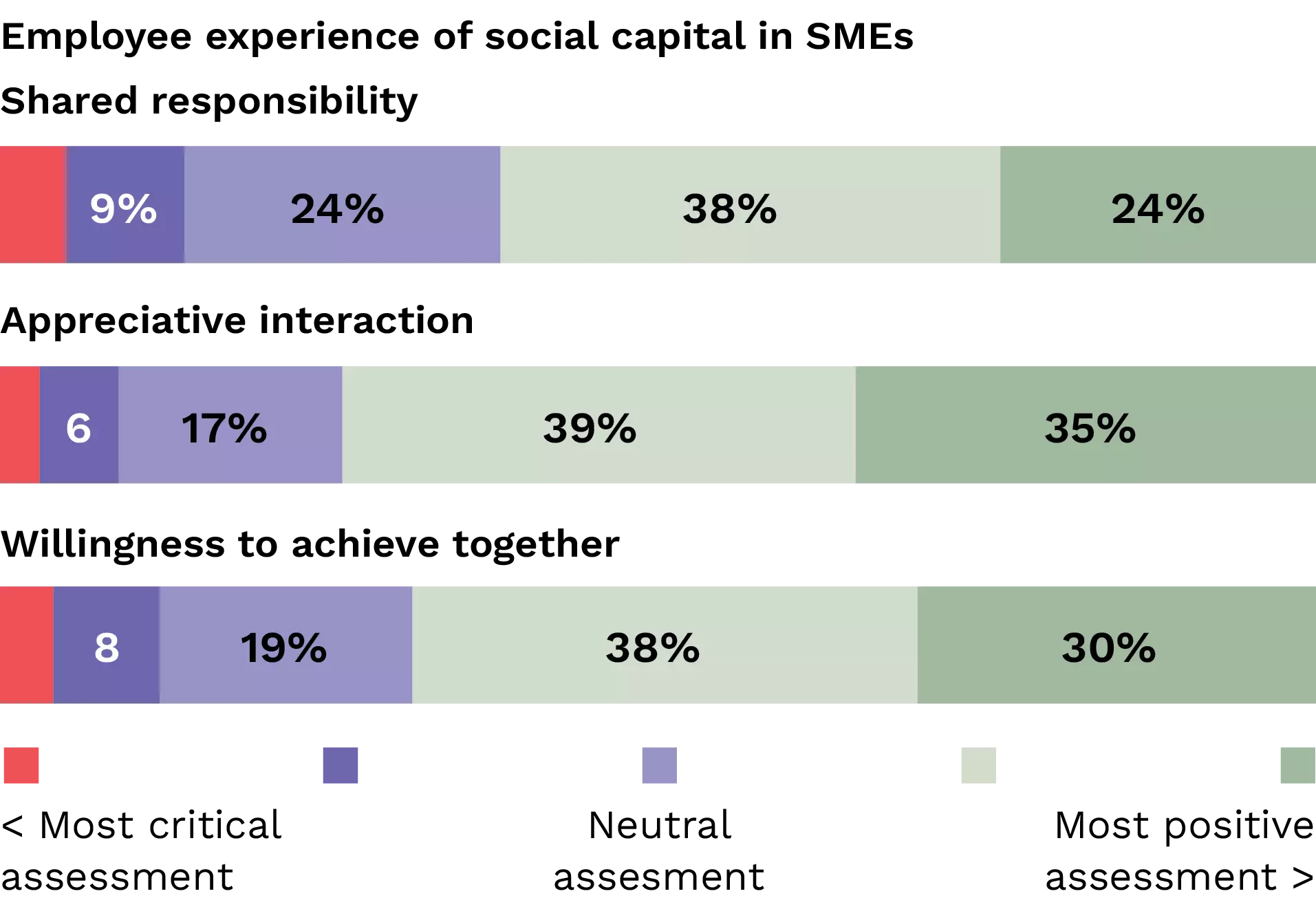
The social capital of a work community is built above all on shared responsibility, respectful interaction, and a collective will to achieve results. Social capital also emerges through a company’s external networks in the form of knowledge and resources that support business operations.
Elo’s study on Social Capital
Using machine learning methods, the study provides new insights into the relationship between social capital and work ability, workflow fluency, resources that support business growth, and job satisfaction.
Key Findings of the Study
- In small and medium-sized enterprises where the experience of social capital is strong, 61% of employees give their workplace a recommendation score of 9 or 10. When the experience of social capital is below average, the share of recommenders drops to less than one-third.
- Work flow is rated better in companies where social capital is stronger than average.
- The proportion of employees who assess their work ability as poor is more than twice as high in workplaces where social capital is below average.
- Work engagement and confidence in the future are common among small business owners.
- Support provided by the network for competence development is associated with better work ability, stronger work engagement, and more positive views on company growth among small business owners.
The Importance of Social Capital Will Become Even More Pronounced in the Future
Competence development increasingly relies on interaction within the work community
The changing world of work and rapid technological development highlight the importance of continuous learning. Work communities also need active knowledge sharing between employees at different career stages to ensure that tacit knowledge transfers from one worker to another as demographic structures evolve.
Hybrid and remote work create new demands for leading workplace functioning, sense of community and community spirit
With the rise of remote work, developing workplace functioning and strengthening both the sense of community and community spirit, as well as ensuring smooth collaboration, have become even more important. Digital tools enable new ways of sharing information and staying connected, but they also emphasise the need to intentionally build and support these aspects.
The importance of networks has grown in a changing operating environment
Networks make it possible to cross organisational boundaries and draw on a broader base of knowledge and expertise. This is particularly important for a company’s ability to renew itself and identify new business opportunities.
Strengthening social capital is a way to promote employees’ work ability and improve company productivity.
In the future, it will be increasingly important to harness the power of social capital and respond to the need to develop it. Social capital is not only a resource for employees or individual companies, but one of the key factors in strengthening the competitiveness of Finnish working life.
Entrepreneurs’ networks create the conditions for wellbeing and growth
Strengthening social capital is a way to promote employees’ work ability and improve company productivity.


Solutions for Strengthening Social Capital in On‑site and Hybrid Work
The perspectives presented in this report on strengthening social capital are designed to support supervisors, HR personnel and entrepreneurs. The solutions can be applied in both on‑site and hybrid work.The learning environment available to Elo’s client companies, along with the training provided by Elo, supports the application of these solutions in everyday workplace practices.
